Tuesday, November 17, 2009

A Travel Bracelet

November 15th

I moved into my very own apartment this weekend! After looking at 20-some apartments (some turned down for personal reasons, others because of PC safety and security policy), and trying to explain to my host mother my reasons for wanting to move out, I found my perfect apartment. It's small – a studio apartment with a personal bathroom and kitchen. It has huge windows with an amazing view over the city and a shower with hot water. I looked all over the city, and had three in mind before Peace Corps came to approve my housing. However, at the end of the day, none of them felt right. I would not only be moving houses, but changing families. In Ecuador families are very very close. It's normal for children to live with their parents until they get married, and even then parents often have a hard time letting their children leave the house. The family is number one in Ecuador, and these traditional feelings shine through with my host family. My host mother lives on the same street as her parents, her husband's parents and five of her siblings/ siblings-in-law. In fact, my new apartment is across the street from my host family, it's in her mother's house. It feels great. I have family all around me, but I have my own space. I can leave my papers and books out, read till all hours of the night, and make my cafe and avena in my underwear :). While I still need a few things (a stove, a broom, some curtains), but I feel safe and happy here – it will be easy to start calling this my home.

I have been in Ecuador for five months now. It's longer than anytime I have spent away from my family and Colorado. There are days when I miss home, the US, my family, and all my amazing friends. There have been days when I call loved ones, and the sound of familiar voices makes me want to jump on a plane and head home. The worst is when things are wrong, and all I want to do is give someone a hug – but, I hug doesn't have the same sentiment when it occurs over the phone. But this travel has just begun. I'm starting to feel comfortable here, and would love to show some foreigners around (hint, hint, wink, wink).

Before I left the states, Ella and her sister Michelle gave me a travel bracelet from South-East Asia. It was hand-woven blue thread with bright beads and small seeds all the way around. The story goes … with this Travel Bracelet, put it on at the beginning of your travel. During this time, make wishes, hopes, dreams for the coming adventures. Eventually, once your travel dreams are ready to take form - the bracelet will fall off. At this time, all of your travel karma will be released into the Universe. During your travels, your good thoughts, hopes and dreams will come back to find you. I've worn my travel bracelet for the past 5 months, through training, my time living with my host family and the first three months of my work here. During this time, I thought often of the meaning of the bracelet and my reasons for traveling to Ecuador. Last night, I was moving my last load of stuff from my host family's house to my new apartment. I started looking around, to make sure I hadn't let anything. My host mother came to my door and told me she was going to miss me. We started talking about some of our plans for the coming years, how we were going to stay in touch and special days we wanted to spend together (yes, my new apartment is right across the street). I looked in all the drawers for left thing, and under the bed, where, I found my broken Travel Bracelet. I've found a place to call home and people to call family.
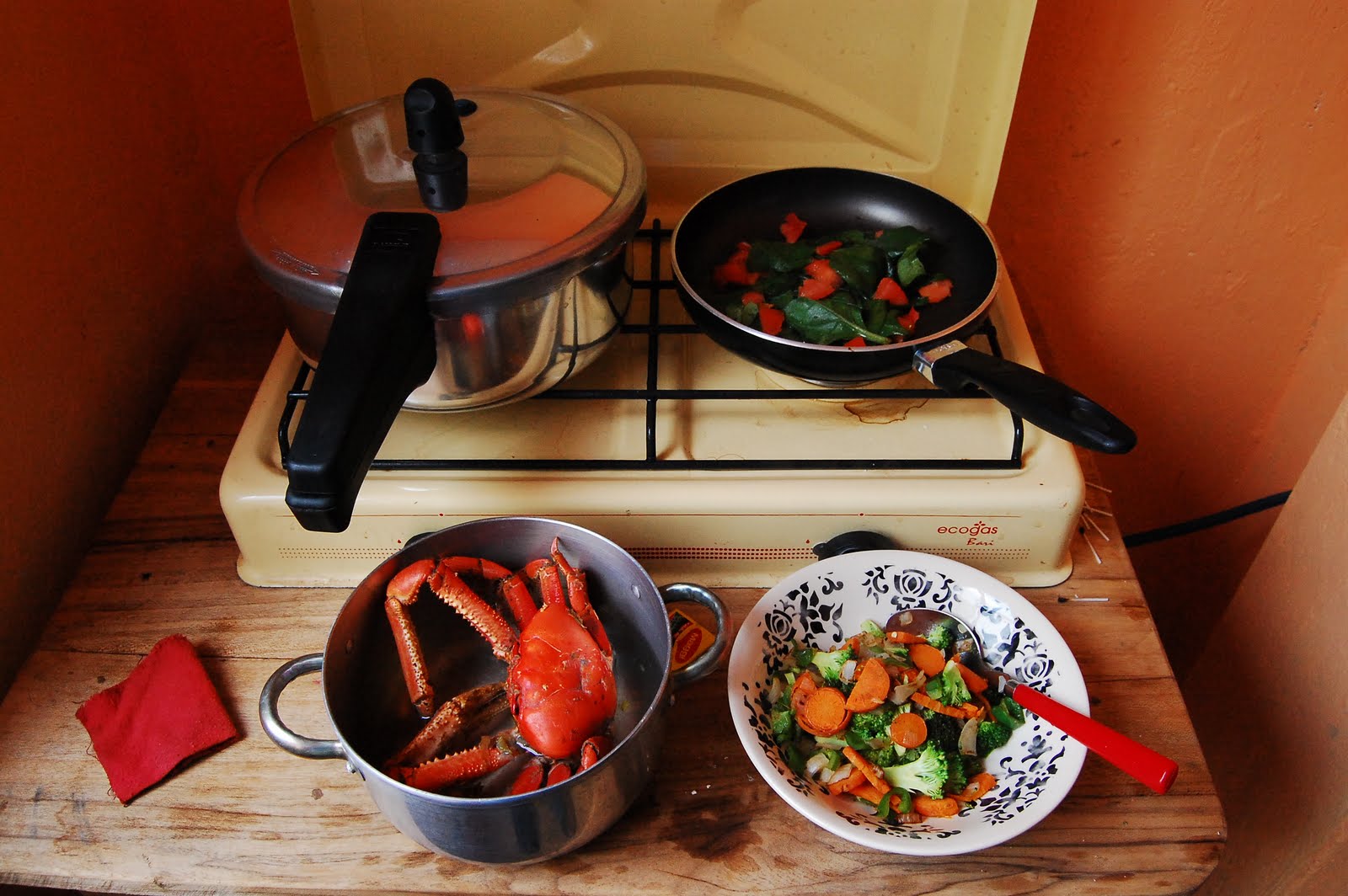


First solita-almuerzo!
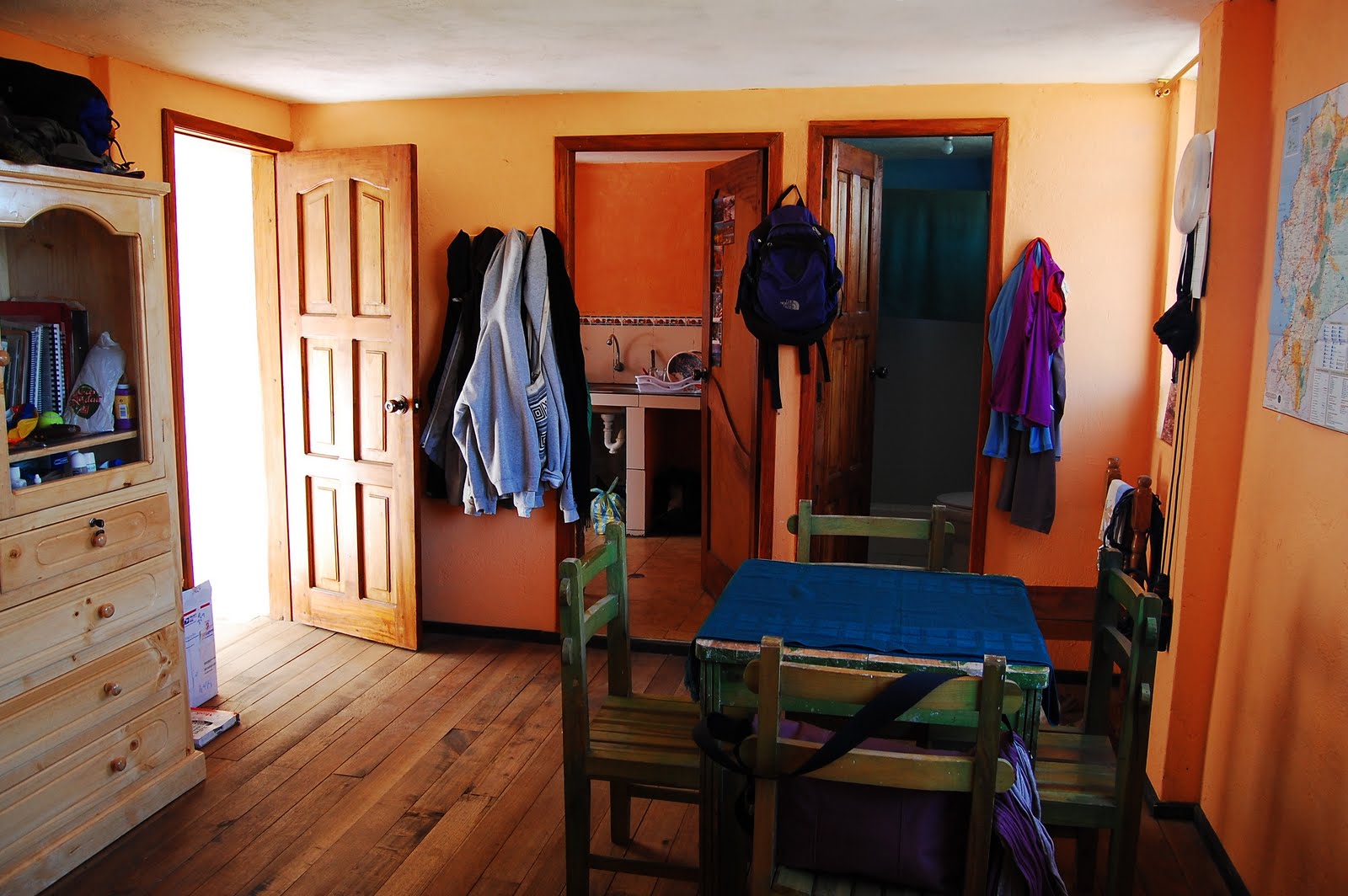

The door on the left goes outside, the middle one goes to my kitchen, the one on the right the bathroom.
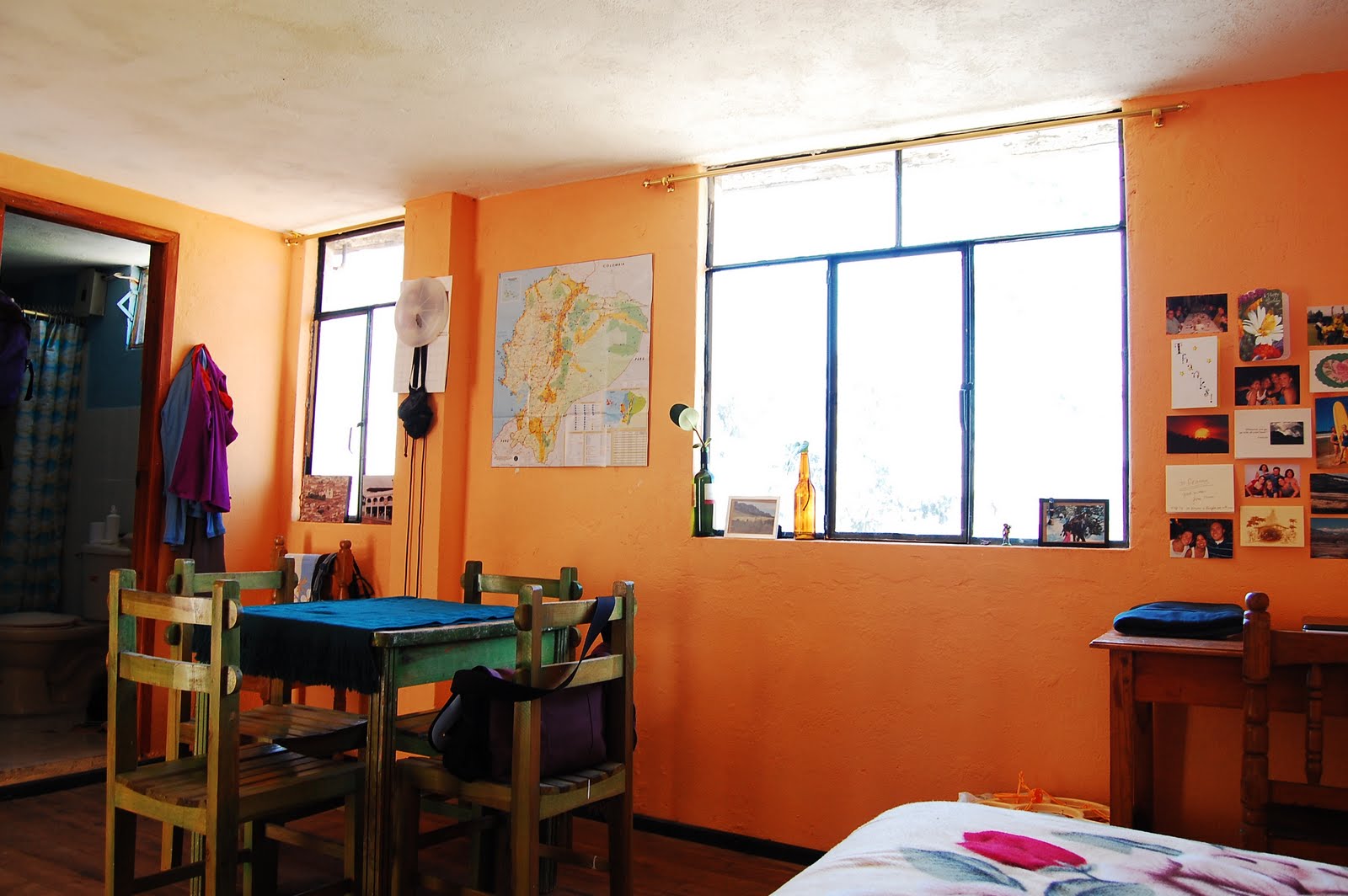


The view from the windows is over all of Guaranda :)

Friday, October 23, 2009

Mental Health Breaks

One of the great inventions of Peace Corps for us Volunteers are Mental Health Breaks ... they are 2 3-day periods during the month when we are able to visit other volunteers, see other areas of Ecuador, or for PCVs out in the campo - a chance to check mail, use the internet, and go to a market in town. They are an amazing opportunity for us to see other parts of Ecuador, get to know other volunteers and re-energize for the coming weeks.

This past weekend PCV Peyton came to visit me! Two Ecuadorians I work with took us on a bike ride from Chimborazo to Salinas. At first, we were told it was going to be an hour and a half bikeride, all downhill. That quickly became a joke as we went up into the clouds to start our 7.5 hour ride (with a modest 3 hours uphill). Words just won't do the photos justice ... PHOTOS

Saturday, October 3, 2009

My work.

I know... two posts in one day! I've had both of these blogs started for at least a week, and today is Saturday and I'm working in the office, so I have time to update.

Three weeks ago (or maybe four...) I spent visiting 5 communities in the Sierra. This past week (or two) I spent visiting 6 communities in the Coast. My head is spinning from stimulation overload, but I love it!

My work operates in the “red zones” of the Provence Bolivar, or the poorest communities (of the poorest Provence in Ecuador). My work reaches out to them to better their living conditions through resources, knowledge and income generating opportunities. They focus heavily on organic agriculture, health, human rights, and woman's empowerment (I know, I know, how did I get so lucky!!?!). They have hundreds of projects going on, so learning the ins-and-outs will probably take me my two years alone!

The Provence Bolivar is considered half Sierra and half Coastal. The climates, geography, and cultures within these two areas are very very different. The Sierra consists of both indigenous campos and mountain communities. The Coastal is made up of coastal people, but not beach-coastal, mountain-coastal. I'm rambling, but I hope you start to get an idea of the diversity.

Just when I've started feeling comfortable with my Spanish around people, I go to the Sierra, where they speak Kichwa (Ecuador's most common indigenous language). A few of the schools I will be working in are bilingual – the majority of students speak Kichwa in their homes, and then learn Spanish at school. Each of the schools are very different – the students, the buildings, the teachers – each paints a small picture of their lives, the history of their families, and their stories of love and tragedy. I won't make you read all about all my visits … but here's just one …

7am Wednesday morning I meet Melania at a market in the center of town to leave for the two school visits we had planned for the day. Melania helps the schools build and maintain school huertos (gardens), at the first school we went to on Tuesday, the older kids in the school helped us plant seeds while we chatted and got to know each other – today, I remembered to wear more sunscreen to work in the sun. We walked for about 15minutes to a bridge where we met with the teachers of the school to take a camioneta to the community. A camioneta is a truck-taxi. Basically, as many people as possible pile into the bed of the truck to move from place A to place B. At times, more than 15 people are standing in the truck beds – I've seen as many as 20!! (Tina – I need to put pictures up for you!)

Once at the school, Melania introduced me to the teachers and spoke with them a little about who I was. Each of the teachers kept asking what I was going to do and if I was going to be there everyday. But, that's the funny thing about my work here – I don't know what I'm going to do until I see (1) the community needs, and (2) community interests. Also, since I'll be working in several schools, I'm unable to visit them all everyday. So, I really have no idea what I'll be doing/ who I'll be working with until I know more about the school and community – and this was my first visit ... after trying to explain that I was here to help with what they wanted me to help in, we walked over to a concrete court (In the US it would look like a basketball court, but here they play voli and soccer on the cement), where the entire school was lining up, in rows according to grade.

At attention, facing away from us towards the school director, they greeted him and at his command, made a half turn to face Melania and me. In unison, they greeted us and all 80-pairs of eyes looked timidly at us. I looked at Melania for her to begin speaking, but she was looking at me.

Introduce yourself she told me. So, in my broken Spanish I said hi to the kids and explained a little of where I came from and that I was going to be working with them for the school year. After a short explanation, I looked back at Melania for some direction so we could begin working on the huertos. I figured we would divide out the older kids, like we had done in the previous school and take them to work on the school huerto.

I was not expecting the words that followed – Play something with them.

My brain shut down – I knew we were coming to visit the schools, but I expected to simply help out with the huertos and to casually say hi to students around the school. Thank goodness I was a YMCA leader, and for PC's dynamicas we did everyday during training, I was able to “Simon dice” and “Cuando yo digo...” my way through the next 30 minutes.

Although it was completely not what I expected that day, while reflecting, I think – what else did you expect? Seize the day. Es la vida.

My coastal experiences have been very different. Traveling to the coast takes 2-3 hours, but is the most beautiful drive – descending thousands of meters into a sub-tropical paradise. My co-workers call me crazy for liking the drive – it's mainly dirt road, hot, at times very dusty and long – well, maybe this is still the honeymoon phase of cultural adaptation, or maybe I have my dad's love for 4-wheeling after all. Eitherway, I must say, some of the most beautiful sunsets I've seen.

The first time I went to the coast was to distribute food rations to communities. In one day we went to three communities and distributed around 80 rations of food. Each of the communities has a community contact who Promocion Humana contacts to let the community know when and why PHD is coming. One of the communities we went to was very well organized; when we arrived at the selected meeting place, all the families were present to receive their rations. At the other two, it took a little more time to distribute the rations to everyone - some of the communities appeared very unorganized, or it could have been lack of motivation to come get the food rations or simple that phone service cuts in and out at times and they didn't hear the news. Either way, working to unite the communities to work with PHD is a key to success. Without them working and interested in the projects, FPH does not succeed. Because FPH only visits each community once or twice every month, the communication and organization the community has within itself is crucial to the sustainability of the work we do.

In the coast, we received regalos (presents) of oranges, bananas, and various other delicious fruits! There have been days where they field promotors I'm working with don't stop for food -- these fruits have been a life saver for me!

In both the Sierra and the Coast my Foundation has worked with family organic huertos (vegetable gardens). While traveling, we visit the gardens. It's amazing to see some of them - with the three A's: Amor, Alimentacion and Agua, they grow like crazy! The majority of the farmers here in Eucador use chemicals to grow their veggies, so a large part of our projects are to educate and start oganic huertos for families and schools! Next just might be cooking classes.

Friday, October 2, 2009

A love story.

Last weekend I went to a wedding!

At 7pm we arrived at the Cathedral in downtown Guaranda for the mass. My host grandmother had invited the family to come (her niece was the bride-to-be). So, Nancy and I decided to tag along with the family. We came equipped with a juice-maker and pressure cooker as presents and rice to throw on the newly weds as they exited the church. When we got to the church, people outside told us the mass started at 8pm. It seemed a little strange, but it's Ecuador and everything starts late! We took the time to stop in at my favorite cafe downtown – Siete Santos - and order hot chocolate and cheese (Gemma – you have to try this!!), which is delicious and my new favorite treat. The cubed cheese turns soft and chewy in the hot chocolate. Just trust me, you have to try it!

When we returned to the Cathedral there was lots of commotion going on inside and outside. Inside, at the front near the alter, there were a group of people crowding around the groom. There was a rumor going around that someone didn't want to marry someone. (Pause for *gasp*) My host grandmother and aunts quickly took off to assess the evening's happenings. A few men came into the church and were directed (rather forcefully for being inside a Cathedral) to sit in the pews at the front. The news came back to us that the friend's of someone didn't want them to get married. (Another pause for *gasp*) A few short minutes later, the bride came in running and in what appeared a confused state. She was wearing her wedding gown, and rushed to the front of the church where the priest and groom were. Soon the couple was talking to the priest. People started to be shushed out of the Cathedral, and as we made our way to the back, the lights turned out and after the last person left, the large doors were closed. The couple and the priest still inside. (*Gasp*) Outside, everyone tried find an explanation for what was happening - we figured out it was the groom's friends who didn't want the couple to wed.

In Ecuador, it's tradition for both the groom's and bride's parents to give their blessings to the couple before they wed. When the couple came out and hopped into a camioneta, everyone said – to the party. The priest had married the couple alone in the church! So, off we went, to the mother of the bride's house.

Once we got to the house, the pain of the newly-weds was present. The importance of family and friends here in Ecuador was displayed strongly as the bride was consoled by all. However, soon, as well, the love of the fiesta shone threw, and all began to dance the night away.

The next morning, I learned more of the previous night from my host mother, in fact, it turned out to be more explosive and thought-provoking than I initially anticipated. (Pause for *Gasp*) It was the groom's friend's who were protesting the wedding. The reason - the groom comes from a lighter skinned family and his friend's didn't want him to marry a woman with dark skin. (*gasp*) They had gotten him wasted before the wedding and locked him in a room. (*gasp **gasp*) Finally he escaped and called his fiance and told her to meet him at the church, that he still wanted to marry her. (Hence why the wedding was delayed an hour.) At the Cathedral, the same friends came to protest the wedding. With too much confrontation and anger, the priest had hold everyone to leave while he privately married the desiring couple. *SIGH*

I send out my best wishes to the newly-weds. I can only imagine the difficulties of trying to start a new life together without the support of your friends. This degree of discrimination is not often seen in Ecuador. However, it is a county of extreme differences – cultures, geography, history, climate, and skin color. I find it respectable and amazing that a small country, the size of Colorado, is still uncovering these differences and learning how to live peacefully with them.

Tuesday, September 15, 2009

Alta Mira, Echeandia, Ecuador

I went to the jungle this past weekend ... well it really was the coast, but it felt like the jungle.

A few photos ...


My host sister and I went to help my mom cook for a local cooking competition. We cooked all day preparing for 100 peole to show-up, eat our food, and vote for their favorite. I guess the people organizing the event didn't publicize very well ... because, noone showed up! It was an unfortunate event, but we went exploring anyways...


Alta Mira.


A little haven in the jungle.


They had an ostrich, tiger, turtle, birds, fish and snakes!


There were 7 waterfalls on the property ... photo with Ide and Waterfall #2.


Waterfall #1 and the swimming pool.


Hiking to the top of the hill ... my host mother got some help from the horse.


Sunset over Echeandia, Ecuador. Our guide and his daughter.


Plus ... weekend live entertainment!
Posted by Picasa

Tuesday, September 8, 2009

Ecualessons

1) Take days one at a time - planning the next day's activities is often a waste of time. No, I'm not saying we shouldn't have goals for the future, but micro-planning or micro-managing (at least in my 3 weeks of experience) has repeatedly failed me. It's the spontaneous people, conversations and visits that work the best.

At work, my first few weeks here have been a slow start. I'm getting to know my office at Foundacion Humana Diocesana (FHD) and the people here; but, according to Peace Corps, the office and Guaranda are not my community. These first months (until January) we are asked to complete CAT (Community Assessment Tools). Basically, we are supposed to go house to house, asking questions concerning the resources and needs of the people in our community. It appears to be a great way to diagnose sustainable development and project potential. At FHD I'll be working in the communities around Guaranda (the province of Bolivar has eight Cantons, FHD works in all of them) – so for CAT, I need to focus my analysis on these communities around Guaranda. This past week, I had my first two dates set to visit communities with promoters (the individuals who work for FHD in the field, or in the different Cantons). Tuesday I went to a town called Quesea with the promoter Melana to meet with the teachers and talk about what I could do at the school; in the sierra the children hadn't started school yet, they started yesterday. The week before I had been trying to speak with Melana about what we were or weren't going to do at the school, what the community was like, what kind of youth program we could implement (or what charlas we could give). All week I felt like I was failing, we talked, but I always left the conversation with the same questions I had started with. Last Tuesday, for our trip, we had a 25 minute ride out there, a 20 minute conversation with some workers about their cheese machinery, followed by meeting one teacher for 5 minutes, and then returned to the office. It was a good lesson - the visit to the school however short, helped me understand how important my relationship with the promoters in the Catons will be. During our 25 minute ride home, I had the best, unplanned conversation with Melana, and it came through our chofer, and basically we started talking about how I didn't know what I was doing. Not in the broad goal sense, but in the small detailed day to day stuff – I don't have a program of exactly what I want to do and who I want to do it with. He started explaining to Melana that we need to work closer together, that I might be nodding my head yes when she speaks to me, but that doesn't mean that I understand everything. Melana and I talked about how we needed to get to know each other better, and I expressed that I hope this is our project, not mine. These conversations are good to keep in mind – I need to learn to keep expressing myself over and over until I'm sure people understand me, and then say it once more.

My second visit on Wednesday was to the Canton Caluma to work with the promoter Melina at six schools which were all in session (it is a coastal Canton, and their school are in session). In previous conversations, Melina and I had connected and I was excited to go spend time with her because of her enthusiasm for me to be there and the common project ideas we had talked about. Because the kids were in session, it was going to be a little easier to get a feel for the communities, and we planned on starting some CAT and doing some work (a charla) with a class. Long story short – Tuesday night I ate some bad mani molido (peanut butter), went to bed at 8pm and didn't get out of bed for 24hours. So much for planning CAT and charlas!

2) I'm Sola - Everyone asks who your novio is and assures you that after two years you'll be married and wont leave Ecuador.

(too many stories, I don't know where to start...)

3) Just say “si” to every invite
Last Thursday, my actual birthday, I had a wonderful dinner with PCV Nancy. (She found queso frito – which looked and tasted enough like crunchy Cheetos to make me smile). Upon calling it a night and returning home, I encountered my aunt and cousins at my house who came to wish me Happy Birthday. Their personalities fill the room - they love to talk, act out stories and we laugh MUCHO! Thinking it was merely talk, I agreed to go running with the younger cousin, Angelo at 5AM the next morning. True to his word, at 4:58AM I heard my host mother calling for me -- "Angelo esta aqui. El gustaria correr. Va?" (“Angela is here. He want's to run. Are you going?”)-- Sure enough, he bounded into the room, ready to run. Upon seeing me in my PJs ... he declared he won (I guess we had made a beat the night before...). I started wondering if I was dreaming or not – I had just gone to bed 4.5 hours before and those queso frit/ crunchy Cheetos-wanna-be's were still lurking in my stomach, not happy with the thought of an early morning jog. But then the voice (and face) of my co-trainers from our 8 weeks of training in Cayambe popped into my head - “You're first months there, just do everything. Don't say no.” They'll be happy to know, I took their advice; and to my surprise, the night was beautiful - full moon, brisk weather, pleasant company. In fact, I think I found myself a running buddy (although I doubt he'll live up to Amy and Cole)!

4) Talk to everyone – you just might fall in love.

Honestly, I keep enjoying the random conversations I have with the Bon Ice kids, the man who makes carrot juice, the security personal at Tia ... but since I'm writing this blog in bed Monday night, I'll write about the person I met today … After lunch, I wondered down the the pizzaria to hang out/ find my cookbook I thought I had left there. I couldn't find my cookbook in my office, so after using the internet, I stuck around the pizzaria for a little with my friend Deanna (I know, cool, ha – I swear it's another person). The cook in the back came out and showed me the “Buen Provecho” cookbook I had been looking for, I had left it there the week before! We started talking about the English, PCV-written “cooking in the campo” cookbook, and although he couldn't understand it all, he really liked the book. He wants to learn to cook, wants to learn more about food and nutrition and wants to cook dishes in Ecuador that use more fruits and vegetables and give people a more balanced diet. We talked about traditional cooking here in Ecuador and how a lot of people don't want to try anything new; however, the market sells a plethora of local fruits and vegetables. Most Ecuadorians don't utilize fruits or vegetables into their cooking/diet. In Ecuador specifically, the almuerzo (lunch) is such an important family meal (its the largest meal of the day and children and parents alike usually return home around 1pm to eat), changing the way almuerzo is prepared in the home would help increase nutrition and health of Ecuadorians. There are Universities to become a chef in the larger cities, but none in Guaranda … so he's going to try cooking new dished with Buen Provecho; I offered to try everything he makes. To top off this conversation, he told me he would also love to take a class in Photography. He thinks it's a shame when Ecuadorians live in such a beautiful place but don't like to look at it. He said that people don't like to travel or see new places, and he wishes he always had a camera so he could show Ecuadorians how beautiful their land is … :)

5) Latin American host mothers ROCK
My host mother is the best. Tomorrow she is leaving for Echeandia to prep for this weekend. What's happening this weekend?? An Iron Chef type taller (another word for charla, although these are usually longer and more of a demonstration – I think), without the competition of Iron Chef, and she has more than an hour. She's going to prepare a 4 course meal for 100 people with three main ingredients -papacuna, yuca and platano. Additionally, she can only use ingredients that grown in Echeandia as well (apples don't grow there, so she can't use apples). All day today we invented new dishes incorporating traditional Ecuadorian dishes, made them and tasted them. GOOD LUCK!!


6) Estoy aqui

In the US, if someone asks you how you are, it's common to say “I'm good”, no matter your real situation. We work hard to appear happy, successful, wealthy, even if we are not. Often, happiness is a role we play to cover up pain; but if covered up for too long, depression, overreacting or breakdowns might quickly develop. In Ecuador, if you ask someone how they are, they usually respond with “estoy aqui” - I'm here. They are willing to talk about the pain of their lives and don't feel the need to pretend their day is great if it's not. At first when I got here this phrase kind of bothered me. I wondered why people wanted to go through their lives merely being, it appeared an easy out for not living and for not grasping their lives and living them to the fullest. It reminded me of conversations you have with people where all they want to do is complain and don't want to try and fix what they are complaining about. However, after spending sometime here with the people, I realize its good to be realistic – we are all just here, living.

I don't want to live everyday saying, “estoy aqui”, but I do want to think twice before saying “I'm good”. For me, there needs to be a balance between the two responses -- somewhere between the realist response “I'm here” and the optimistic response “I'm good”. That balance comes by realizing when and why you can't honestly say “I'm good”, and by learning to understand what makes you feel unhappy.

Monday, September 7, 2009

Birthday

My Birthday was this past week! Thanks for all the thoughts and messages, I missed being around close friends and family, it was great to hear from everyone.

This past weekend, the Ecuadorian family helped me celebrate with an Ecuadorian party. Being my first birthday in Ecuador - this was obviously my first experience being a host at an Ecuadorian party … How did I do? Um.... I flopped big time, and, possibly made the biggest rookie host-mistakes – not enough food, a HUGE no-no here in Ecuador. My aunt nicely assured me that I was forgiven since this was my first party, and everyone appeared to enjoy themselves throughout the night. But, here, a topic of conversation the day(s) after a party is about the sobras, or plate(s) of leftover food that the host gives you upon leaving a party to take home. From here on out, I will always cook double when preparing for guests in Ecuador.

One of my sweet PCV friends came into town for the weekend, but other than that, I hadn't made any plans to do anything for my birthday. That's where I got lucky to have such an awesome host mother/family- she gathered her family and everyone made sure I knew how to correctly celebrate a birthday (minus the lack-of-sobras). Around noon, my host mother, sister and cousin cooked me two cakes – one vanilla with chocolate frosting and the other chocolate with a white cream frosting, both had strawberry designs on top.

They made apple flavored gellitan, ham-pepper-pickled onion-olive on a stick appetizers, rice and soup. I was in charge of making burritos, so we made 25 tortillas, beans, guacamole, and aji and cut up cheese and tomatoes. I figured this would be more than enough, and shrugged off preparing a chicken as well.

After the family showed up, I got my face plastered into a cake ...

The burritos, cake, rice and gellitan were quickly demolished and we had a four hour dance party. The living room barely fit everyone, but no one seemed to notice. The kids started playing a lime-on-a-spoon dance competition. Everyone holds their spoon with a lime on top in their mouth while dancing, if you drop your lime you're out, the last person dancing wins! Then we played various balloon games, like: “dance with a balloon between two people”, “balloon hot potato”, and “hit the balloon back and forth”. Like a lot of Ecuadorian games I've experienced, these games consist of punishments for the losers. Let me explain in a little more detail, for “balloon hot potato, ” if the music stops and you are holding the balloon, you have to do a penatencia (penalty or punishment), which is anything the other people make up in the room that you have to do. This particular night, it usually included dancing in the middle of the circle or moving your body in some other funny manner in front of everyone. The rest of the night was filled with dance parties. I tried to but on some American music, but they kept wanting their beats ... I need to get YMCA and the electric slide for the next party ...

It was a fabulous party and everyone enjoyed themselves ... even though they went home empty handed :)